Type "best Shopify agency for supplement brands" into ChatGPT. Or "best DTC mattress under $1,000" into Perplexity. You get a short paragraph with a handful of brands named in it. Some brand earned each of those mentions. The question every founder asks once they notice this is simple: how do I become one of the named brands?
Most people selling AEO cannot answer that past "use schema and write good content." That is not an answer. It is a shrug with vocabulary.
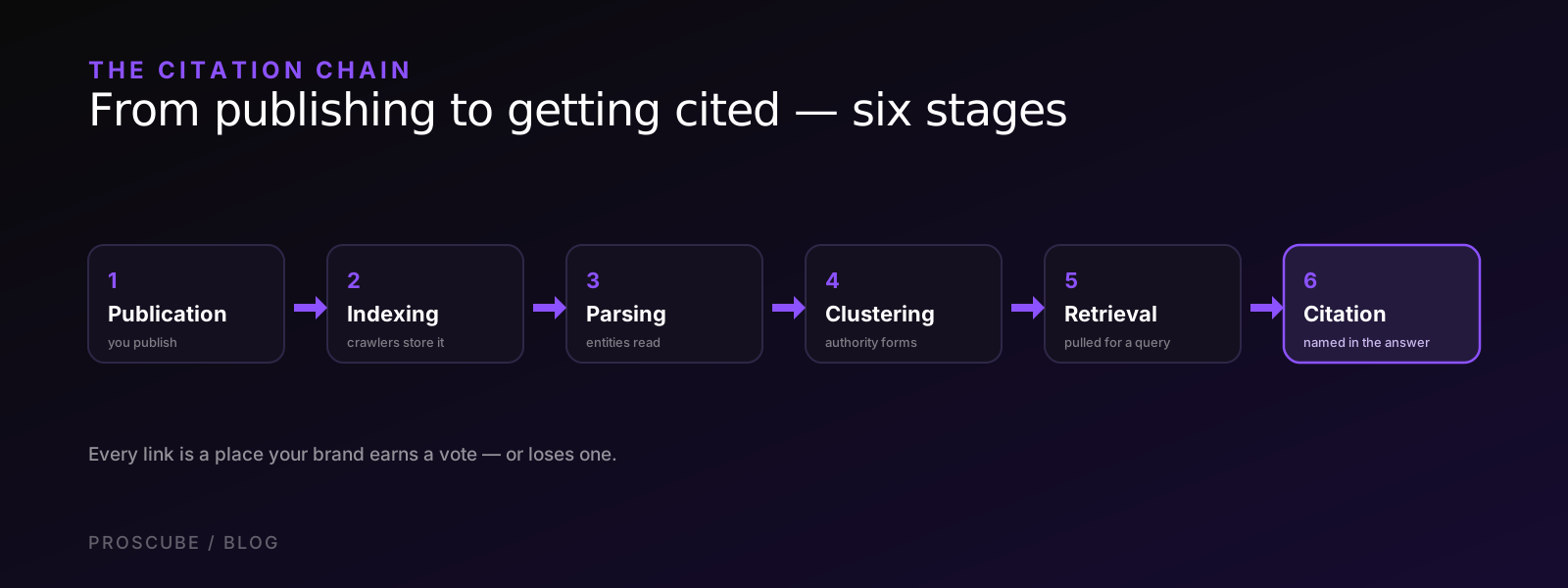
Citation is not magic, and it is not arbitrary. It is a chain. Your content has to exist in a form a machine can read, get indexed by the right systems, get parsed into entities the model understands, get clustered into topics you are seen as authoritative on, get retrieved when someone asks a relevant question, and finally get selected for the answer over other eligible sources. Six stages. Each one is a place your brand either earns a vote or quietly loses one.
This post walks the whole chain. At each stage you will see what the system is doing, which signals it weights, and what you can actually do about it. The point is a working model of how citation happens — because the tactics change every quarter, and the mechanism does not.
Why this matters now
Search is splitting in two. Google now puts an AI Overview above the blue links, so a growing share of searches end without a click to anyone. ChatGPT, Claude, Perplexity, and Gemini go further — they answer the question outright, and most of the time no one scrolls to a source at all.
In that world, the brand named in the answer wins, and the brand that merely ranks tenth on a page nobody opens does not. Your SEO can be technically fine — indexed, fast, ranking — and you can still be invisible, because the answer layer never mentions you.
So the question has changed. It used to be "do I rank?" Now it is "am I in the answer?" Those are different games with different mechanics, and most of the confusion around AEO comes from agencies selling the second while only understanding the first.
There is no trick here, and no shortcut worth selling you. There is a mechanism, and it rewards the brands that understand it. Here is how citation actually happens, stage by stage.
Stage 1: Publication
Before anything else can happen, your content has to exist in a form a machine can find and read. This sounds trivial. It is where most brands already lose, because the substantive thinking that would earn citations is not on a crawlable page at all.
The signals that matter here:
- Server-rendered HTML, not content that only appears after JavaScript runs.
- Canonical URLs, with no duplication scattered across subdomains.
- Public access — no login wall, no soft paywall that blocks crawlers.
- Text-first pages, with images as enhancement rather than as the content itself.
- Stable URLs that do not change every time you redesign.
What you can do: audit how much of your genuine expertise is actually published in crawlable, text-first, public form. For most brands the honest answer is "almost none." The real knowledge lives in support transcripts, founder interviews, podcast episodes, sales-call recordings, and internal docs — none of which a retrieval system can read. The work here is not clever. It is moving the thinking you already have onto pages with real, stable URLs that a machine can open without a browser, a login, or a guess. You cannot be cited for an insight that only exists in a Slack thread.
Stage 2: Indexing
Once your content exists, crawlers from Google, OpenAI, Anthropic, Perplexity, and others have to find and store it. The pipelines are not the same. Being in Google's index does not put you in Perplexity's, and a page Googlebot loves can be entirely absent from OpenAI's web index if you never let its crawler in.
The signals that matter:
- A current sitemap, submitted and maintained.
- A robots.txt that allows the right crawlers — not just Googlebot, but GPTBot, ClaudeBot, PerplexityBot, and the rest.
- Internal linking dense enough for crawlers to discover related pages.
- Load speed, since slow pages get partially indexed or skipped.
- Schema markup that signals what each page is and what it covers.
What you can do: first, check your robots.txt. Most sites either block the LLM crawlers outright or never made a decision, which quietly removes them from those engines entirely — and you cannot be retrieved from an index you were never allowed into. Explicitly allow the crawlers you want. Keep a current sitemap and submit pages directly through Search Console and the equivalent channels each engine offers. This is the least glamorous stage and one of the highest-impact, because a single line in robots.txt can be the difference between existing in an engine and being invisible to it.
Stage 3: Parsing and entity recognition
Now the system reads the page and decides what it is about — not as a bag of keywords, but as entities. People, organizations, products, concepts. It works out that a given name is an organization, that a product is a product, that a named person wrote the page, and that those entities relate to each other within a specific topic. That recognition decides which subjects you are considered to know anything about.
The signals that matter:
- Schema markup with correct @type declarations — Organization, Person, Service, Article.
- Consistent entity references — the same name, spelled the same way, in the same context, everywhere.
- sameAs links tying your entity to verified profiles: LinkedIn, Wikipedia, Crunchbase, official accounts.
- Author attribution with linked Person schema.
- Internal links that reinforce which entities belong together.
What you can do: put clean schema on every page that carries real substance, and keep your entity names consistent — pick one name for your brand and never drift between variants, because the system treats each variant as a weaker, separate thing. Connect your key entities to authoritative profiles with sameAs so the model can verify they are real. And attribute content to named humans with linked Person schema, not to "the team" — an unattributed page is much harder to anchor to an expert, and expertise is exactly what the system is trying to assess.
Stage 4: Topical clustering
The system now judges what your whole site — not any single page — is authoritative on. One excellent page on a subject does not make you an authority on it. A set of interlinked pages covering the subject from several angles does. Engines look for clusters, not isolated brilliance.
The signals that matter:
- Multiple pages on related sub-topics, linked to each other.
- A hub-and-spoke shape: a pillar page linking out to detailed pages on the same topic.
- Citation density between your own related pages.
- Consistent voice and author across the cluster.
- Time depth — clusters built over months read as genuine; a cluster published all at once in a week reads as a content farm.
What you can do: choose three or four topics where you genuinely want to be considered an authority, and build a real cluster around each — a pillar page, supporting pages, posts, and case studies, all interlinked and attributed to the same people. Resist the urge to cover everything; breadth is what dilutes authority. Depth on a few topics beats shallow coverage of many, both for human readers and for the systems deciding what you are credible on. This is slow work, and the slowness is part of why it reads as authentic.
Stage 5: Retrieval
Someone asks the model a question, and the system has to choose which sources from its index to actually pull into the answer. This is the moment ranking becomes citation. The retrieval system weighs how relevant you are to the specific question, how authoritative you are on the topic, how fresh you are when freshness matters, and how often other trusted sources point to you.
The signals that matter:
- Semantic relevance to the actual question, not just keyword overlap.
- Authority signals — entity strength, schema, sameAs density.
- Freshness, for any query where recency matters.
- Backlinks from other recognized sources.
- Quote-worthy phrasing — content with clear, extractable claims gets pulled more than content that buries the point.
What you can do: write so the answer is extractable. State your claims plainly instead of burying them in narrative, because a system can only quote a sentence that actually says something. Use H2s phrased like the questions people ask, so the match is obvious. Refresh content periodically so it stays current on time-sensitive topics. And earn backlinks the only durable way — by being the most substantive answer to a real question, which makes other people link to you without being asked. Link schemes do not survive; being genuinely the best source does.
Stage 6: Citation selection
The final stage. The system has several eligible sources and has to choose which to actually name. This is the most opaque link in the chain — different engines weigh it differently — but the patterns are consistent enough to act on. The sources that get named tend to have real authors, clear expertise signals, recent updates, intact schema, and content that answers the question directly rather than circling it.
The signals that matter:
- A named author with a linked bio — anonymous content gets cited less than authored content.
- Recency, with both publishedAt and dateModified present and honest.
- A direct answer to the question, not adjacent content that almost answers it.
- A citation network — how many other named sources already reference you.
- Structure that surfaces the answer fast: a clear thesis, a summary, the point up front.
What you can do: name your authors and give them real, linked bios. Keep content updated and let dateModified reflect it honestly. Lead with the answer and then explain, instead of building to a conclusion the system has to dig for. Put the citation-worthy claim in the first sentence under each H2, not in the fourth paragraph. The model is skimming for the sentence it can lift into an answer with attribution — make that sentence easy to find, and make it yours.
What the chain changes about your AEO strategy
Seeing AEO as a chain changes how you should spend on it.
Tactics in isolation do not compound. Schema with inconsistent entity names does little. Author attribution with a one-line bio does little. Each tactic works only because of its place in the chain — it depends on the stages before it being sound.
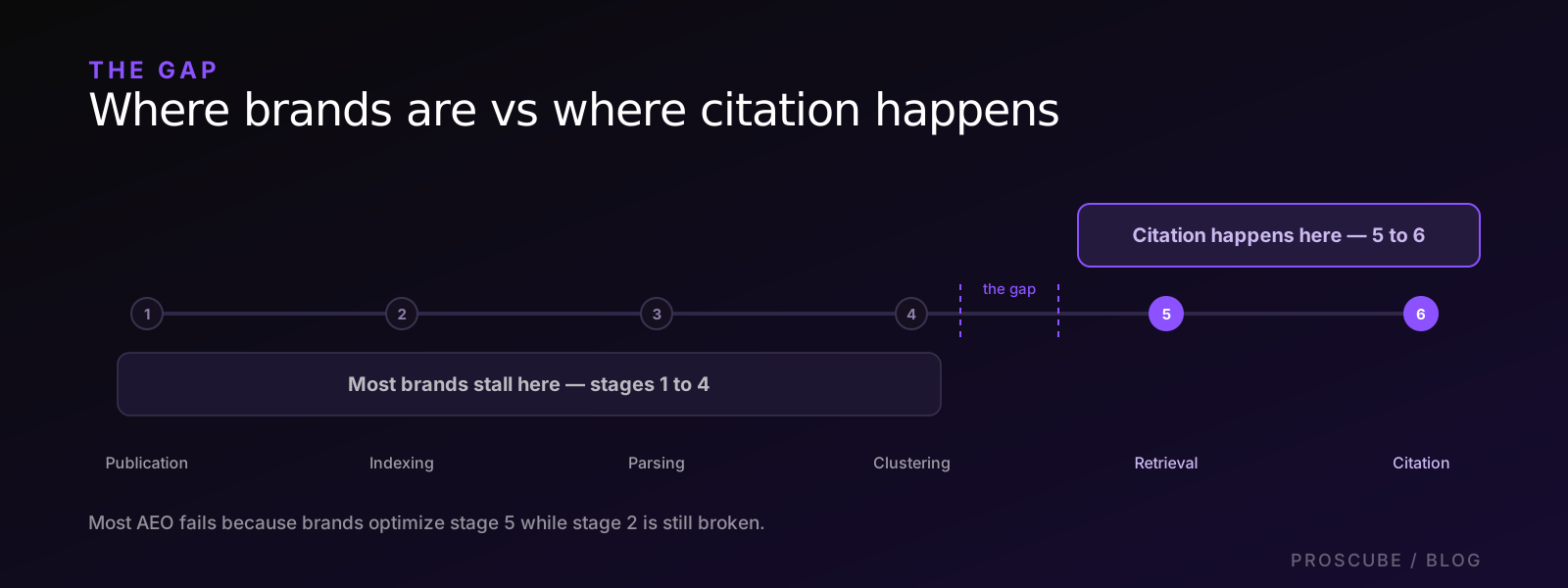
Most agencies sell stage-5 and stage-6 work — retrieval optimization, citation engineering — because that work is visible and demonstrable. They skip the upstream stages because that work is invisible and unglamorous. That is exactly why their results are inconsistent: they optimize the selection stage while the indexing stage is broken.
Real AEO is sequential. Get publication right, then indexing, then entity recognition, then clusters, then retrieval, then citation. Working a later stage while an earlier one is broken is the most common reason AEO spend produces nothing — you cannot be selected from an index you are not in, or recognized as an authority you never built.
The good news is that doing this in order is rare. Most brands have real gaps at the first three stages, which means a methodical, bottom-up approach produces results out of proportion to the effort — precisely because so few competitors are doing it properly.
Where most brands actually are
If you are evaluating AEO, you are almost certainly at one of these points:
- Stage 1 incomplete — most of your expertise is locked in formats a crawler cannot read.
- Stage 2 partial — indexed by Google, invisible to OpenAI and Perplexity because their crawlers were never allowed in.
- Stage 3 weak — no entity consistency, no Person schema, no sameAs density.
- Stage 4 missing — one good page, no cluster behind it.
- Stage 5 and 6 attempted — writing for citation on a foundation that is not there yet.
Find which stage your brand is actually at before you optimize for the next one. Most AEO attempts fail for one reason: the brand pours effort into stage 5 while its stage 2 is quietly broken. The sequence is the strategy.
AEO is not a tactic, it is a sequence — and most agencies sell it backward, because the upstream work is invisible and the downstream work demos well. We are doing it the other way, in public, on proscube.com itself: every signal at every stage of this chain, audited and instrumented on our own site, so the approach is inspectable rather than asserted. If you want the same applied to your brand, the next step is an AEO visibility audit. We will show you exactly where in the chain your brand actually sits, what is working, what is broken, and what sequence makes sense for you — before you spend on tactics that cannot land yet.
About the author
Manpreet Singh
Founder of Proscube. Leads the studio's Shopify, headless and CRO engineering, and works directly with founders rather than through account managers.
More about Manpreet