Proscube
 

Shopify + CRO for supplement and wellness brands

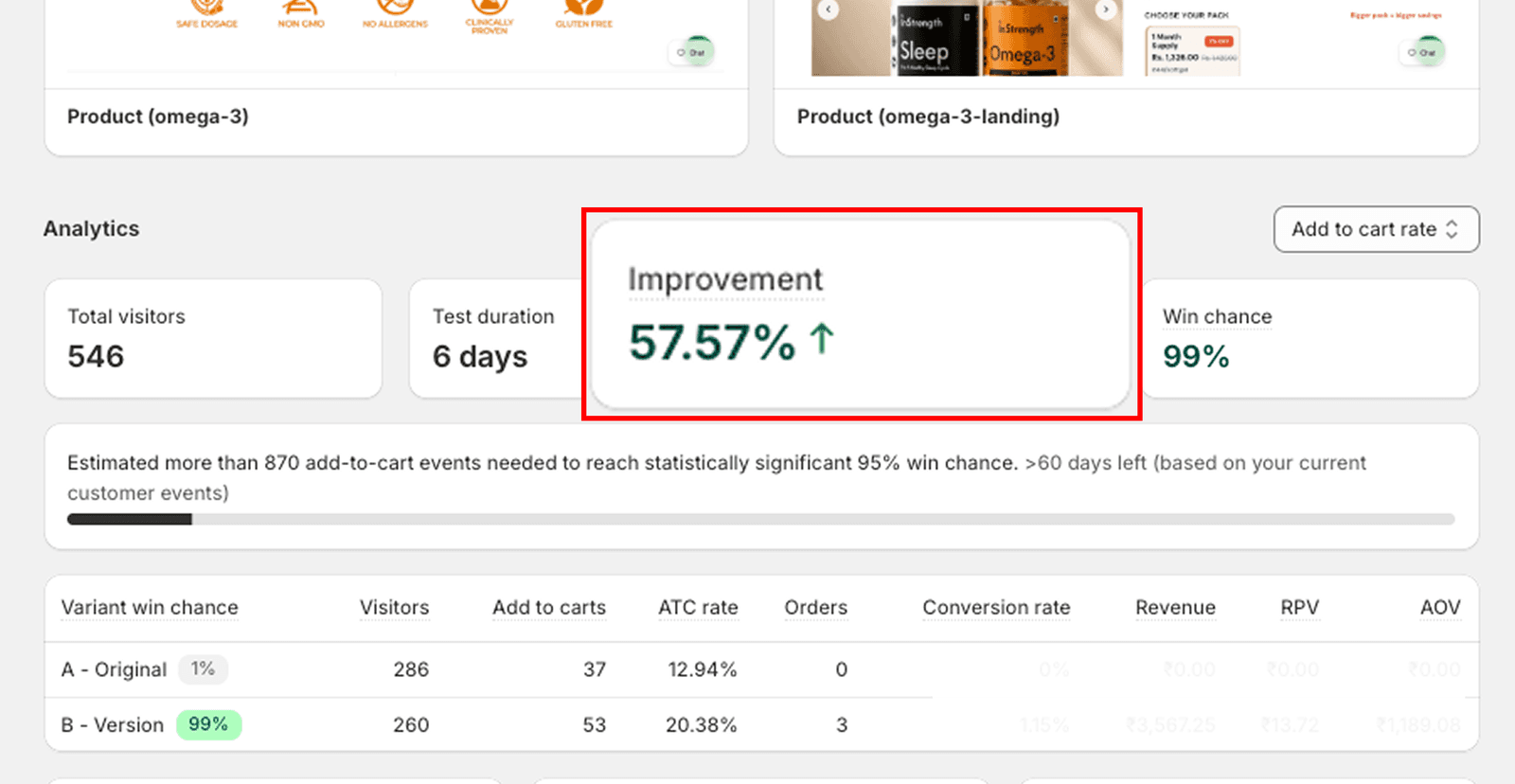
We moved one supplement page from 12.94% to 20.38% add-to-cart. Here is the whole readout.

Including the confidence interval, which is wide, and the order count, which is too small to claim anything from. This page is our work on supplement stores — the brands we have built, the one test we can prove, and what we would ask any agency before signing with them.

Clutch Premier VerifiedShopify Partner
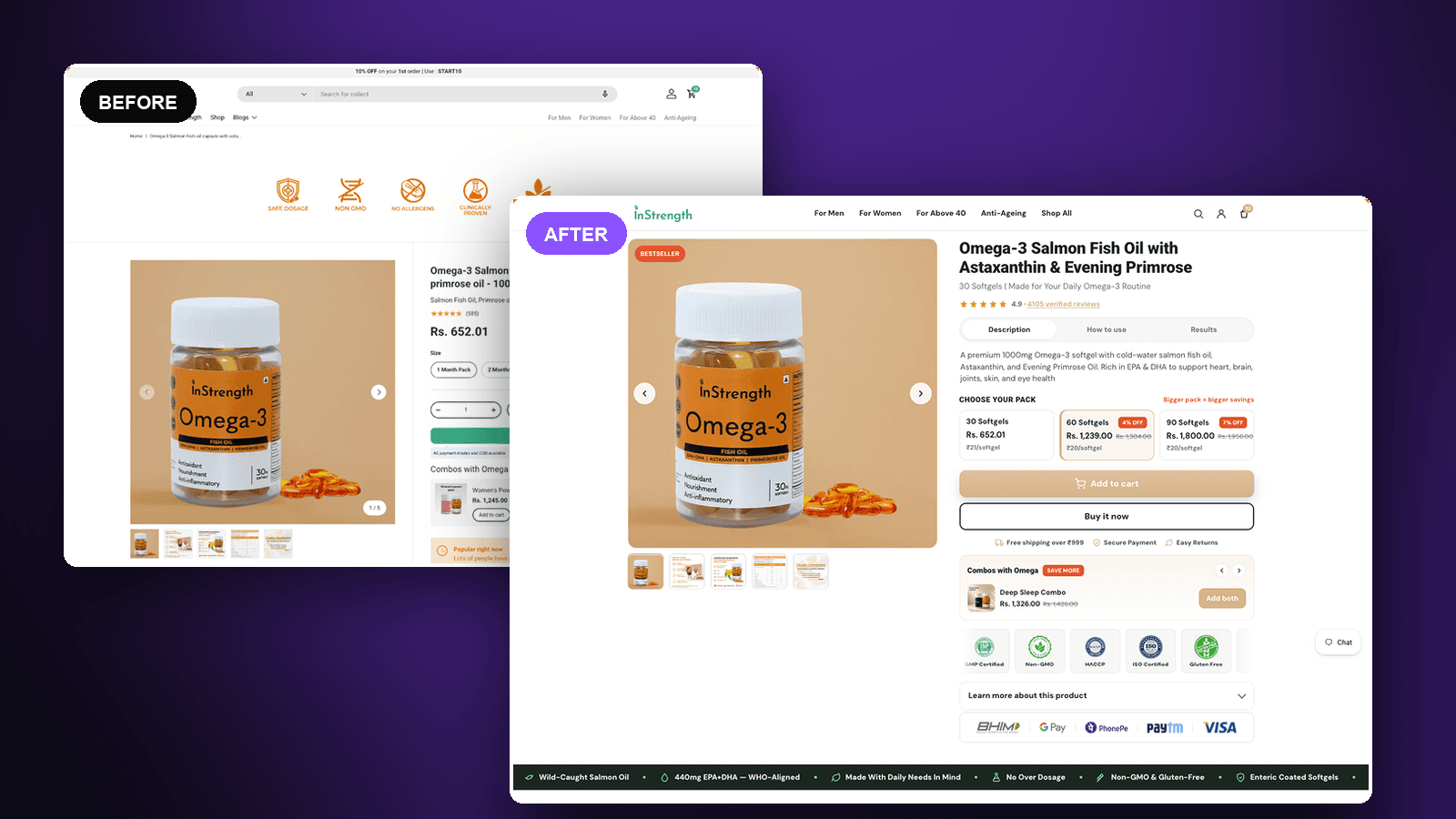
InStrength Omega-3 product page, before and after the Proscube rebuild

Proscube is a Shopify and conversion-rate-optimisation studio for supplement, nutraceutical and wellness brands. We have built and optimised stores for Miduty, Wellbeing Nutrition, Good Monk, Ace Blend and others, and we ship product-page rebuilds as live A/B tests. On the InStrength Omega-3 page, add-to-cart rate rose from 12.94% to 20.38% in a six-day test. We work with DTC brands across the US, UK, Europe and Australia.

57.6%

ATC lift, split tested

80+

Shopify stores built

20+

Shopify Plus builds

200+

Projects delivered

The test

InStrength · Omega-3

Three unpriced buttons became a pack ladder that argued for itself.

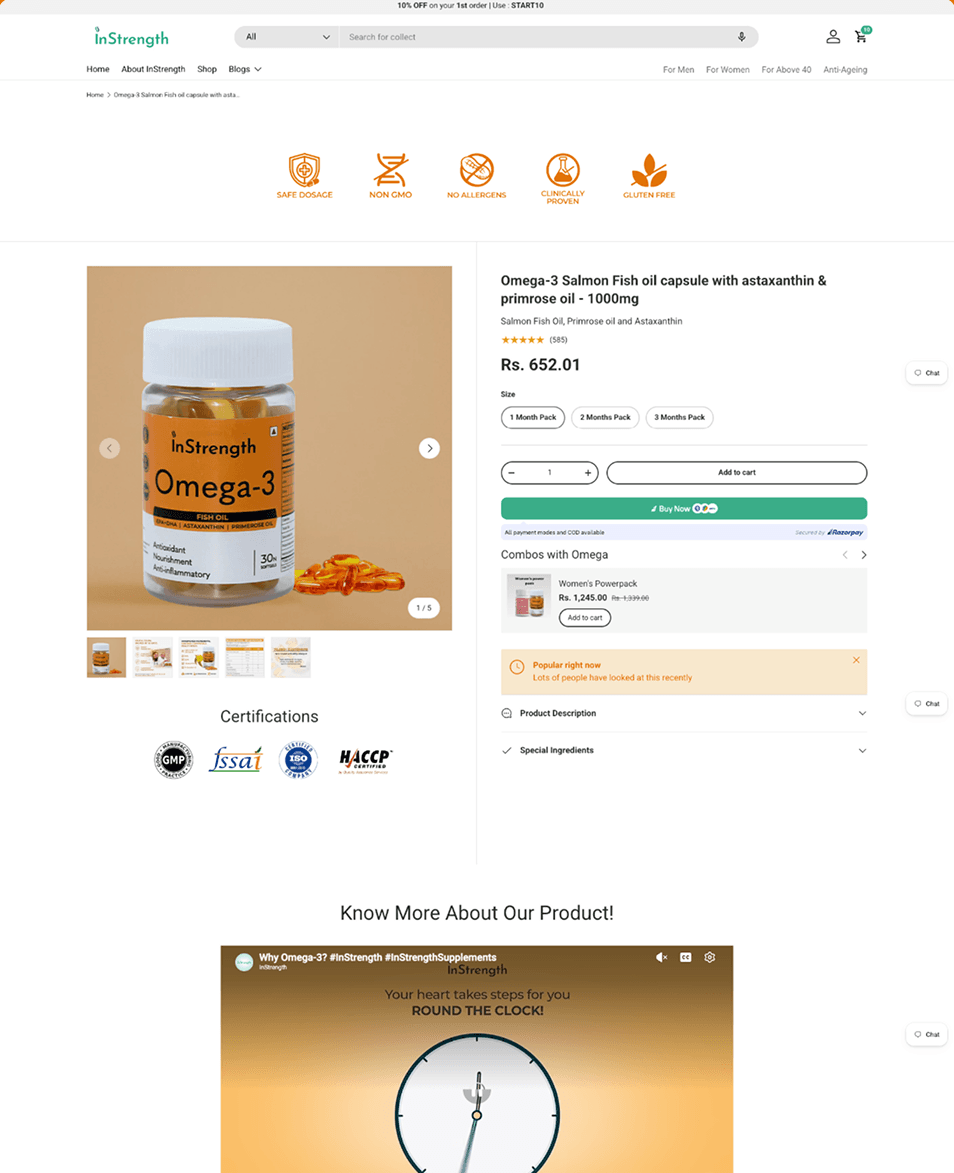
InStrength's Omega-3 page had everything a buyer could want and no order to read it in. A band of trust icons — safe dosage, non-GMO, clinically proven — floated above the product, disconnected from the price. Certifications sat below the fold. The description and ingredients were collapsed behind accordions, so the case for the product was always one tap away from anyone skimming.

The buying choice was the weakest part. Three pack options — one, two and three months — were plain unpriced buttons, so the page never showed what a bigger pack saved you. Add to cart was an outlined control next to a quantity stepper, visually quieter than the Buy Now button beside it.

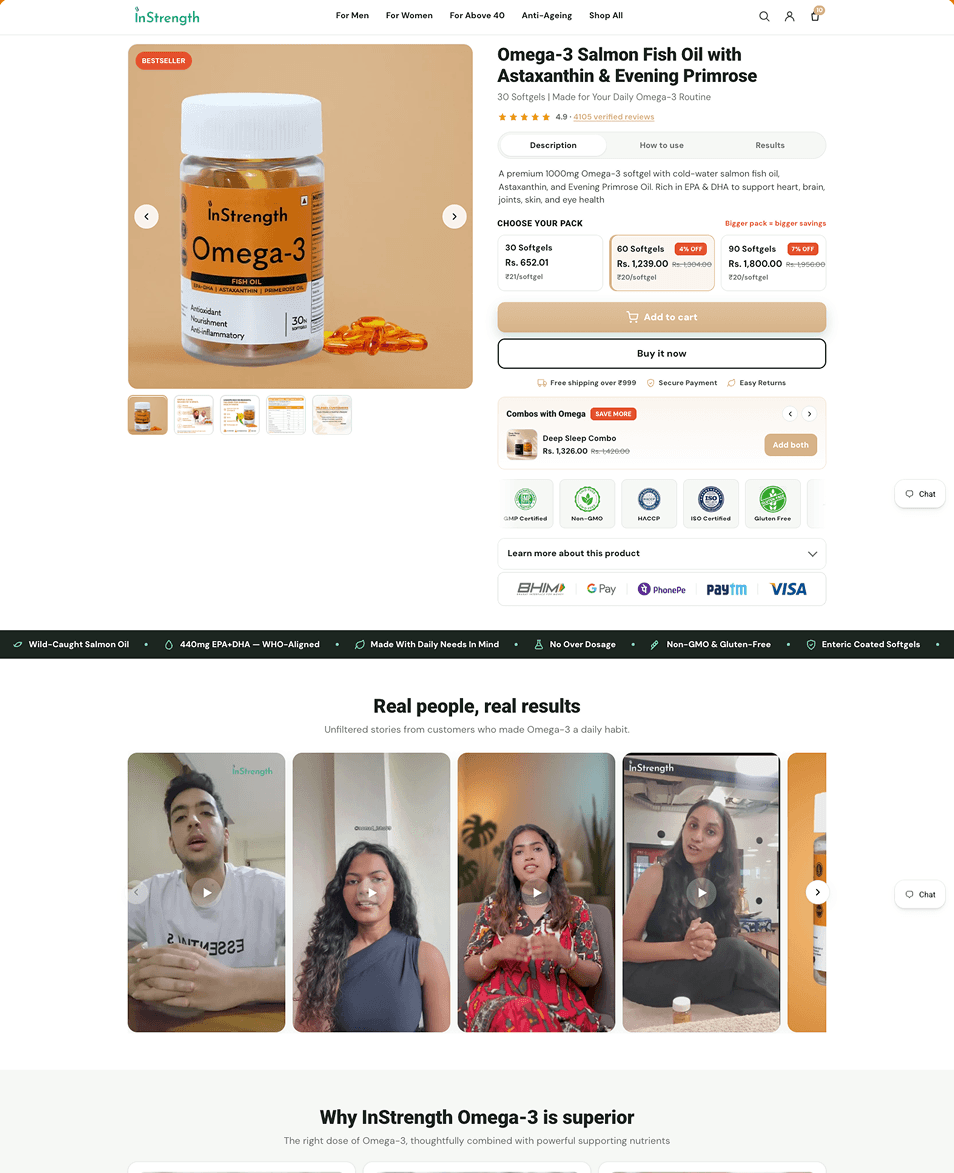
We priced every tier, put the per-softgel unit price under each one beneath a single line — bigger pack, bigger savings — and moved the certifications, shipping threshold and returns inside the buying block. Add to cart became the primary control. The rating moved up as “4.9 · 4105 verified reviews” rather than a row of bare stars.

Read the full InStrength case study
12.94% → 20.38%
Add-to-cart rate, control vs rebuild
+57.6%
Relative lift (best estimate)
p = 0.02
99% win chance
546 · 6 days
Visitors, 50/50 split

The interval around that lift runs roughly +9% to +106%, so 57.6% is the best estimate rather than a precise figure — a six-day test on 546 visitors settles the direction confidently and the magnitude loosely. The rebuild also took 3 orders against 0, which we are not claiming as a result: that sample is far too small to mean anything, and an agency quoting it at you as an infinity-percent revenue lift is telling you something about themselves.

A/B test dashboard showing 546 visitors, 6 days, 57.57% improvement and 99% win chance
The test dashboard as it read at the end: 546 visitors over six days, 99% win chance, and the per-variant table underneath. The rebuild is variant B.

Before and after

Drag it. This is the page that was tested.

The InStrength Omega-3 product page as it was, against the version that won. Desktop and mobile — the pack selector and the review count both land above the fold on phones now.

Product page

The original against the rebuild — same product, same traffic, split 50/50.

Product page — before
Before
Product page — after
After

Selected work

Supplement stores we designed and built.

Nutraceuticals, ayurvedic formulations, collagen, kids’ nutrition and oral sprays — every one of these is our design and our build, not a template we dressed. A few are linked live so you can go and use them.

What actually moves a supplement PDP

Five things wrong with almost every supplement product page.

These keep turning up, in roughly the order they cost you money. The first two are worth more than any hero-section redesign.

01

You are optimising the wrong order

A supplement customer who does not reorder is barely profitable after acquisition cost. Most of the money is in month three, not day one — and yet almost every store, and almost every agency engagement, spends itself on the first purchase. Replenishment timing, the reorder path and post-purchase education are where the value is and where the least work has been done.

02

The pack ladder does not argue for anything

Three sizes as plain buttons is the single most common miss in the category, and it is what the test on this page fixed. Show the price on every tier, show the per-serving cost, and the larger pack becomes legible as a better deal instead of just a bigger number. This is a structural change, not a copy change, and it is usually the cheapest win available.

03

Compliance has been allowed to kill the page

Regulators push you toward cautious language and most brands overcorrect until the page reads as though nothing works — technically safe, commercially dead. The skill is finding what you can actually stand behind: third-party test results, ingredient dosages, published studies, certifications. Lead with those and the hedged adjectives stop being necessary.

04

Subscription is asked for before the buyer has decided to buy

Most of the category stacks subscribe-or-not on top of buy-or-not, at the exact moment you need one clear path. Where the subscription sits, what it visibly saves per serving, and how obviously it can be cancelled decide whether it lifts lifetime value or costs you the first order outright.

05

Everything is on the page and none of it is readable

Ingredients, dosage, sourcing, certifications, testing — all of it has to be present, accurate and scannable at once. Cram it in and the page overwhelms; hide it behind accordions and nobody trusts you enough to buy. Structure carries this. Tabs, not paragraphs.

How we start

You only pay if it wins.

We rebuild one product page — the one carrying your ad spend, or your hero SKU. It goes live as an A/B test against your current page. If our version doesn't win, you don't pay, and you keep the page you had.

We can offer that because the test decides, not us. It also puts the risk of a first engagement on our side of the table rather than yours. If it wins, you pay for that page, and then you decide whether we carry on.

Pick a page to test
  • One page: the PDP behind your ads, or your best seller
  • Shipped live as an A/B test against your current page
  • If it doesn't win, no invoice — and your original page stays
  • If it wins, you decide whether we continue

Choosing an agency

Five questions worth asking. Ask us too.

If you are comparing supplement Shopify agencies, these separate them faster than a portfolio review will. Our answers are underneath each one.

Can you show me a test that lost?

The most useful question you can ask. Anyone running a meaningful number of A/B tests has lost some — roughly half is normal. An agency with no losses either is not testing or is not telling you.

Our answer

Yes. We have shipped rebuilds that did not beat the control and rolled them back. On our skincare page, two of three case studies carry no number at all because we cannot evidence one, and we say so rather than papering over it.

How do you handle claim compliance?

Category-specific, and it separates agencies fast. You want someone who designs around the rules rather than testing their limits — and who is clear that they are not your regulatory advisor.

Our answer

We work inside them daily. We structure pages so the claims you can legitimately make do the selling — third-party testing, dosages, published studies — and we will flag copy that looks likely to cause you a problem. Your compliance counsel signs off on the wording, not us.

Which subscription app will you put me on, and why?

A tell for whether an agency thinks about your economics or its own convenience. Many default to the most expensive option regardless of whether you need it.

Our answer

It depends on your billing complexity. Shopify Subscriptions is enough for straightforward replenishment; Recharge earns its cost when you need real flexibility in swaps, skips and dunning. Most brands we meet are paying for tiers they never use, and we will say so.

How will we know it worked?

Get the primary metric agreed in writing before anything ships. "Conversion improved" measured against last month is not a result — it is a season, a promotion, or a change in traffic mix.

Our answer

One primary metric agreed before we start, usually add-to-cart rate. Even 50/50 split against your current page, reported from the same dashboard you can open yourself. If a page cannot reach a conclusion in a sensible window, we say so before starting.

What happens if it doesn't work?

The answer tells you how the risk is shared. A fixed fee regardless of outcome is normal and defensible — but you should know that is what you are buying before you buy it.

Our answer

No invoice, and your original page stays live. That is the offer above: we take the first engagement on the result rather than on the hours.

Where our clients are

US, UK and Europe, Australia.

Supplements is the category where the regulatory line moves most between markets, and where the same product page often cannot be reused across them without changes.

United States

DSHEA structure/function claims, the disclaimer requirement, and a buyer used to subscribe-and-save as the default. Subscription framing does more work here than anywhere else.

United Kingdom & Europe

Only authorised health claims may be made, which is a much shorter list than most brands expect. Pages usually need restructuring rather than rewording, so the permitted claims carry the weight.

Australia & New Zealand

TGA listing numbers and a market that reads them as a trust signal. Shipping thresholds and pack economics matter disproportionately given the domestic market size.

We work asynchronously and overlap live for calls. We are not your regulatory advisor in any market — we build pages that make your approved claims do the work.

Questions

The ones we get asked.

Something not covered here? Ask us directly.

Understanding that it is a repeat-purchase business. Most of the profit arrives on the second and third order, so a store designed only around the first one leaves the actual money untouched. On top of that: fluency with claim compliance, subscription mechanics that help rather than block the first purchase, and the ability to structure dense ingredient information so it is readable. An agency that has only done fashion will be learning all of that on your budget.

We work within them daily and design around them rather than testing their limits. We are not your regulatory advisor — your compliance counsel signs off on claim language — but we will structure the page so the claims you can legitimately make do the selling, and flag copy that looks likely to cause you a problem.

It depends on your billing complexity and what you already run. Shopify Subscriptions is enough for straightforward replenishment; Recharge earns its cost when you need real flexibility in swaps, skips and dunning. We will tell you when the cheaper option is genuinely sufficient — most brands are paying for tiers they never use.

No, and we would be wary of anyone who told you otherwise. That figure is one page, one brand, 546 visitors over six days, and the confidence interval around it runs from about +9% to +106%. It is a real result and we can produce the evidence for it, but it is a single measurement rather than a rate we can promise to reproduce. What we will commit to is the method and the terms: your page against ours, split evenly, and no invoice if ours does not win.

A new Shopify build runs 4 to 8 weeks, Shopify Plus and headless 8 to 16. A CRO redesign of an existing store is usually 3 to 5 weeks. Subscription logic and ingredient content are the two things that most often extend a supplement timeline, so we scope them explicitly up front.

Usually yes, and it is normally the right first move. The fixes are often structural rather than visual — the pack ladder, the subscription framing, where proof sits relative to the price. We would rather sell you the audit and the changes it justifies than a rebuild you may not need.

CRO work starts at $5K, Shopify builds at $8K and Shopify Plus at $20K. Those are starting points rather than quotes — the number depends on scope and integrations, and we fix it in writing after a discovery call so it does not move afterwards.

Next step

Send us the product page you are least happy with.

Not a brief, not a deck. One URL and a sentence about what you think is wrong with it. You will get a real read within a business day — including, sometimes, that your problem is the reorder flow rather than the page you sent.

Clutch Premier VerifiedShopify Partner