Proscube
 

Conversion rate optimisation for DTC brands

Most CRO case studies would not survive a statistics lesson. Here are ours, including the one that proved nothing.

We split-test the work, publish the confidence interval, and say plainly when a result has not settled. This page has two real test dashboards on it — one that won, and one we will not claim.

Clutch Premier VerifiedShopify Partner
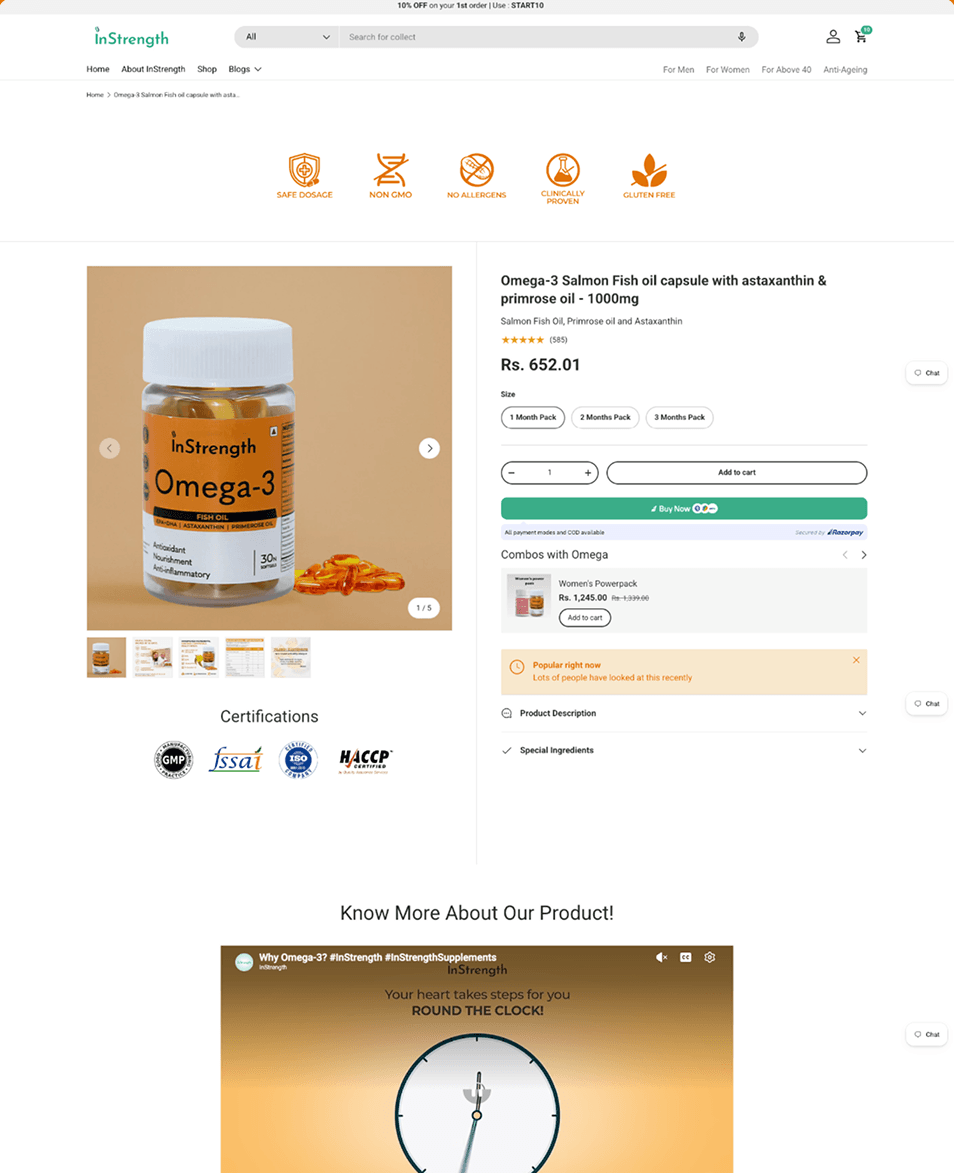
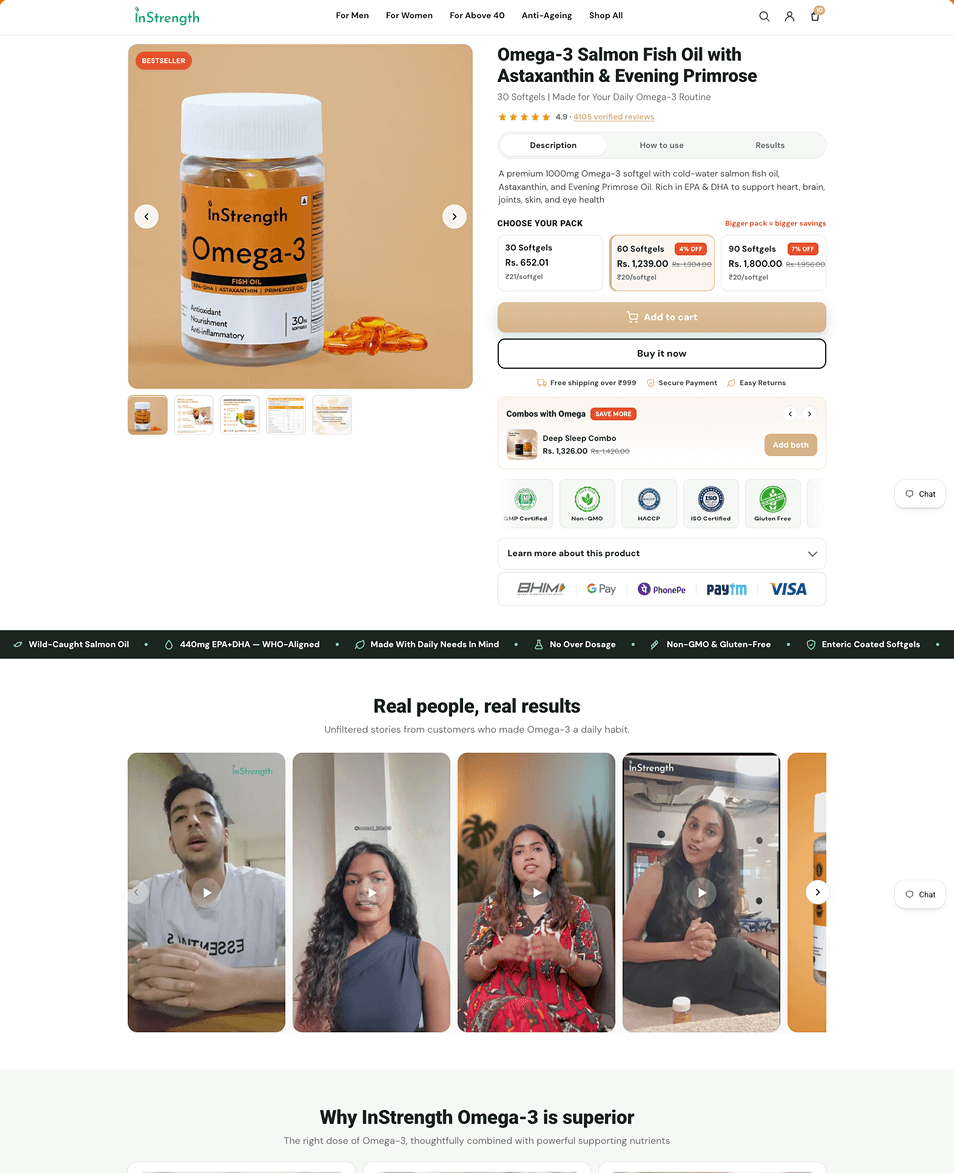
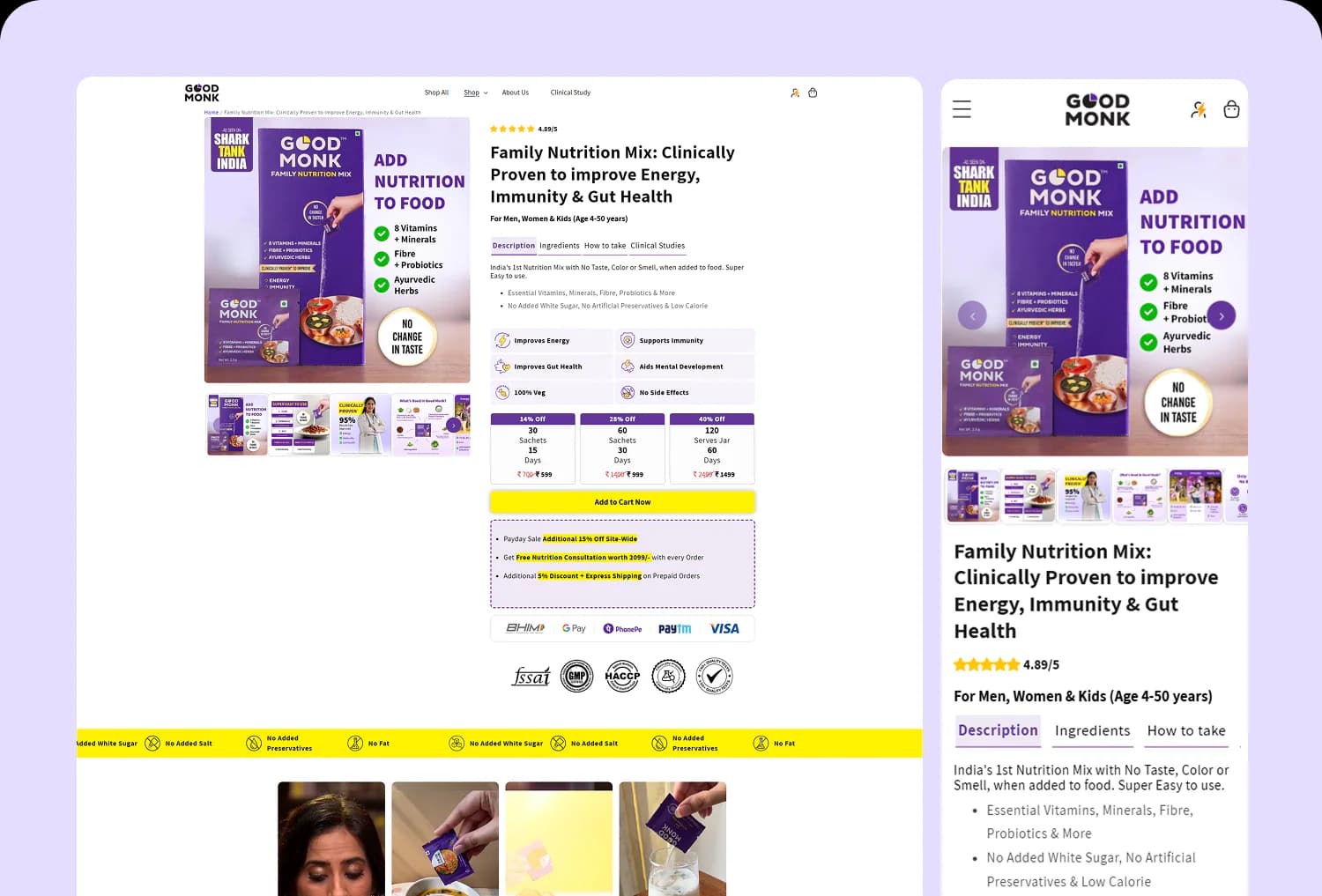
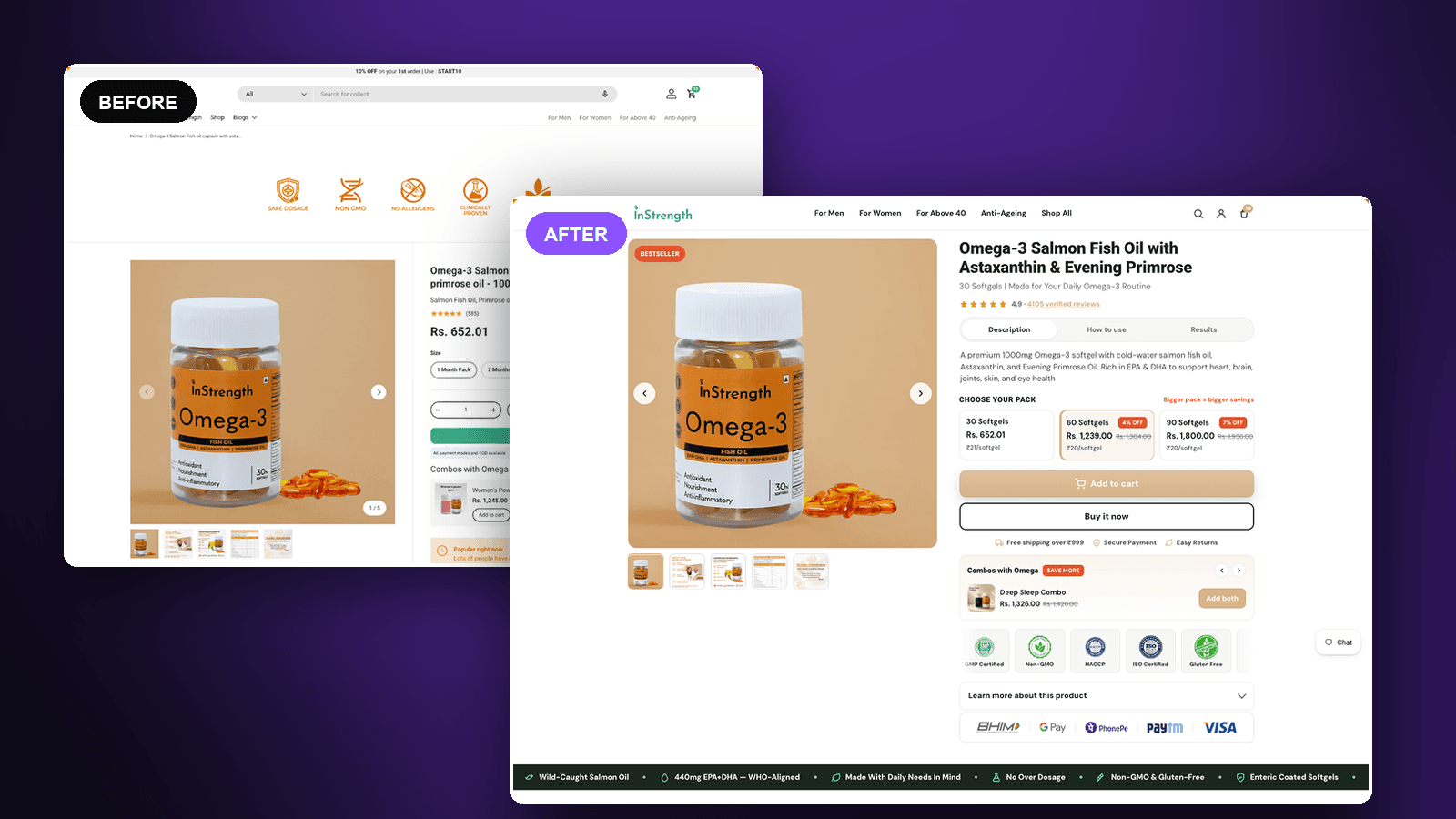
InStrength Omega-3 product page, before and after the Proscube rebuild

Proscube is a conversion rate optimisation agency for DTC ecommerce brands on Shopify. We rebuild the product pages carrying your ad spend, ship them as live A/B tests against the current page, and publish the readout including confidence intervals and tests that did not reach significance. On the InStrength Omega-3 page, add-to-cart rate rose from 12.94% to 20.38% in a six-day test. We work with brands across the US, UK, Europe and Australia.

57.6%

Best measured ATC lift

200+

Projects delivered

80+

Shopify stores built

2

Test dashboards published

The evidence

Two tests. One proved something.

Both ran as 50/50 splits against the live page. Both dashboards are below, unedited. The difference between them is the entire argument for how we report.

Significant

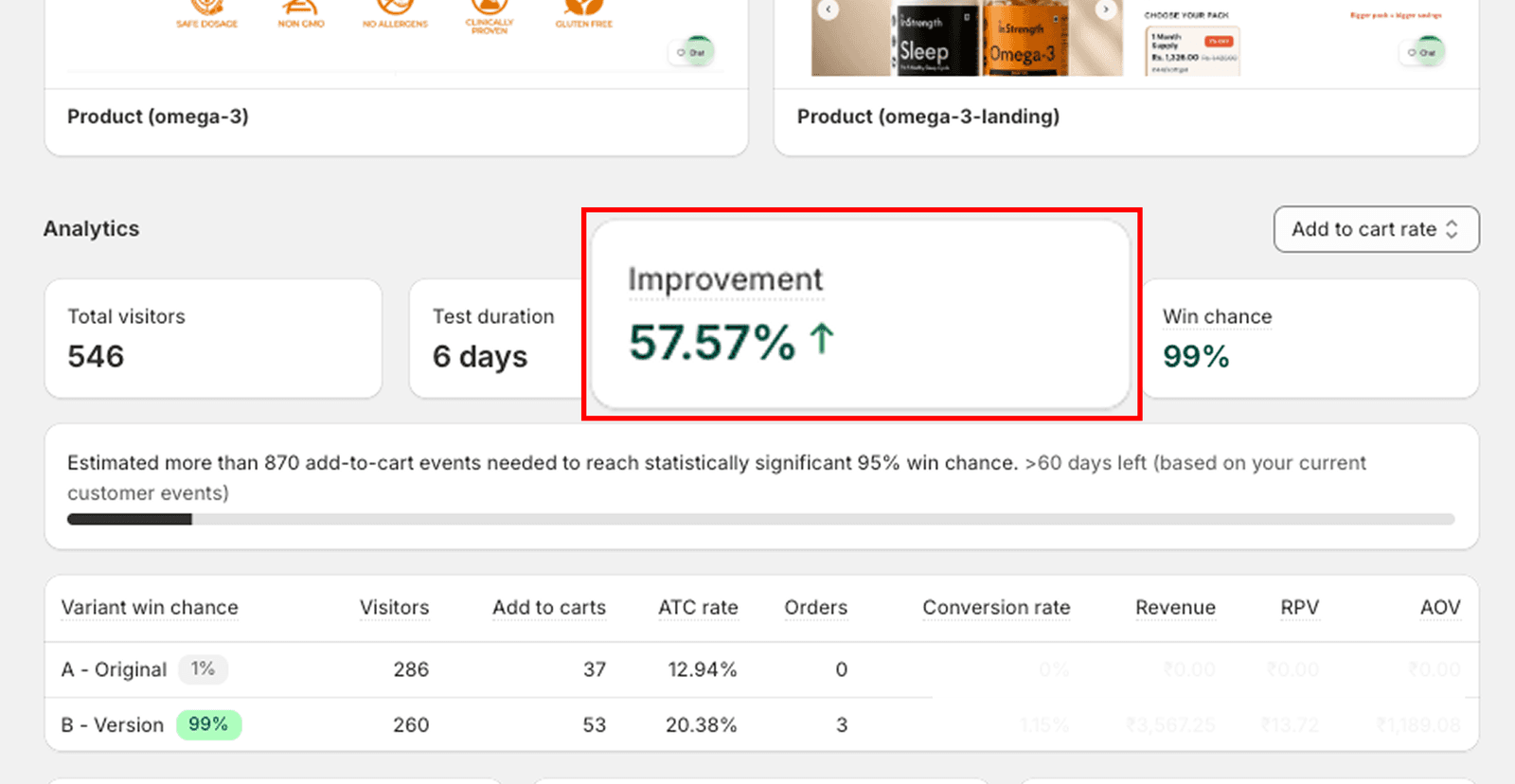
InStrength — add-to-cart 12.94% → 20.38%

Three pack options sat on the page as plain unpriced buttons, so nothing showed what a bigger pack saved you. We priced every tier, put the per-softgel unit price under each, and moved the certifications into the buying block.

Six days, 546 visitors, 50/50. p = 0.02, 99% win chance. The interval around the lift runs roughly +9% to +106%, so 57.6% is the best estimate rather than a precise figure — a six-day test settles direction confidently and magnitude loosely.
Read the full case study
The InStrength dashboard at the end of the test. 546 visitors, six days, 99% win chance, per-variant table underneath.
Not established

Pawpeye — the one we will not put a number on

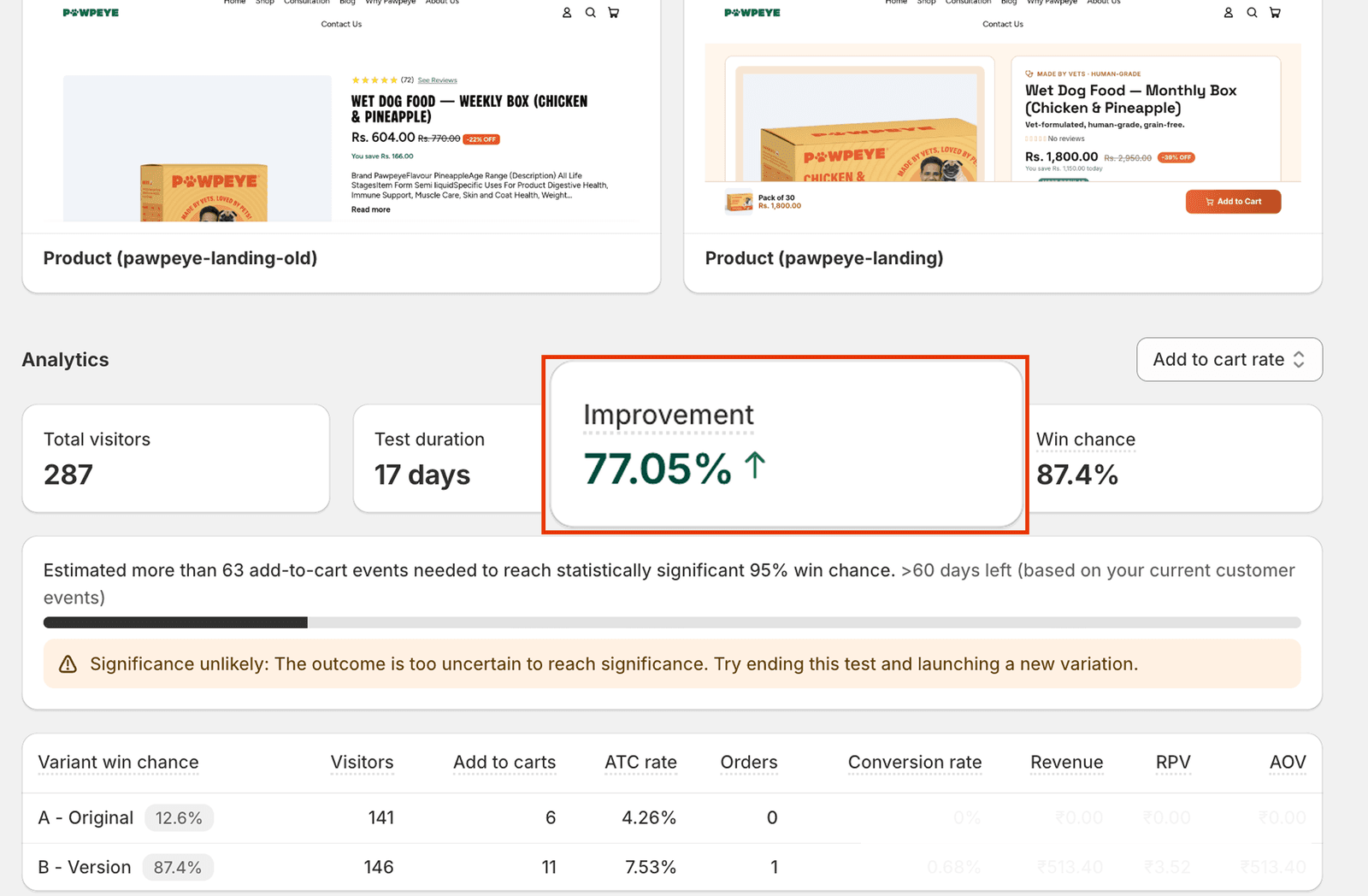
The rebuild led on add-to-cart throughout: 7.53% against 4.26% across 287 visitors over 17 days. As a headline that is a 77% lift, and you will see agencies publish exactly that.

We will not. The whole difference rests on 11 add-to-cart events against 6. The platform put the win probability at 87.4%, short of the 95% bar. Five extra events is not a finding, it is a fortnight of ordinary variance, and the honest description is that the test has not settled.

Read the full case study
The Pawpeye dashboard, including Shopify's own note that the result has not reached significance. Published unedited.

Before and after

Drag it. This is the page that won.

The InStrength Omega-3 product page as it was, against the version that beat it. Desktop and mobile — the pack selector and review count both land above the fold on phones now.

Product page

The original against the rebuild — same product, same traffic, split 50/50.

Product page — before
Before
Product page — after
After

Selected work

Stores we have built and optimised.

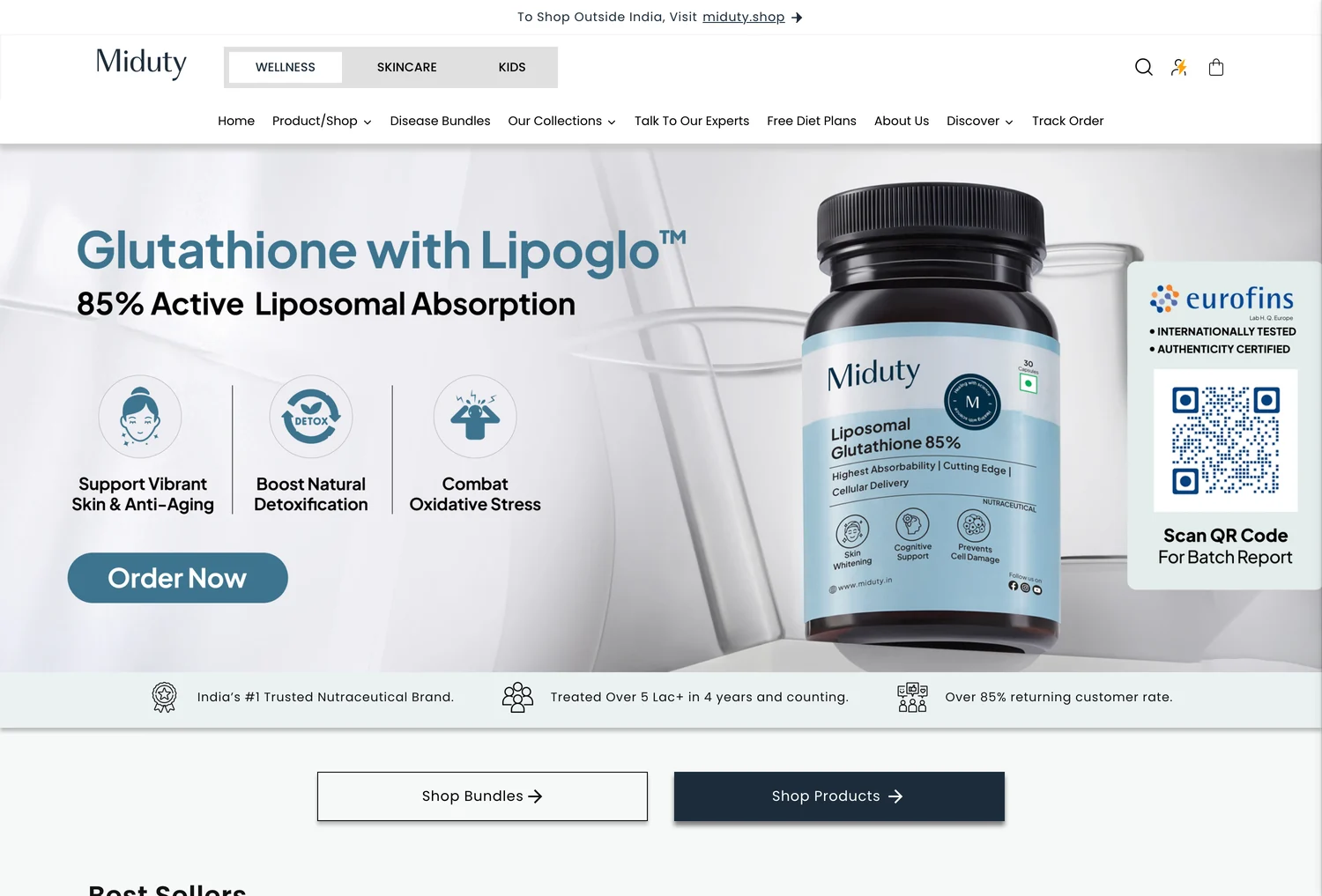
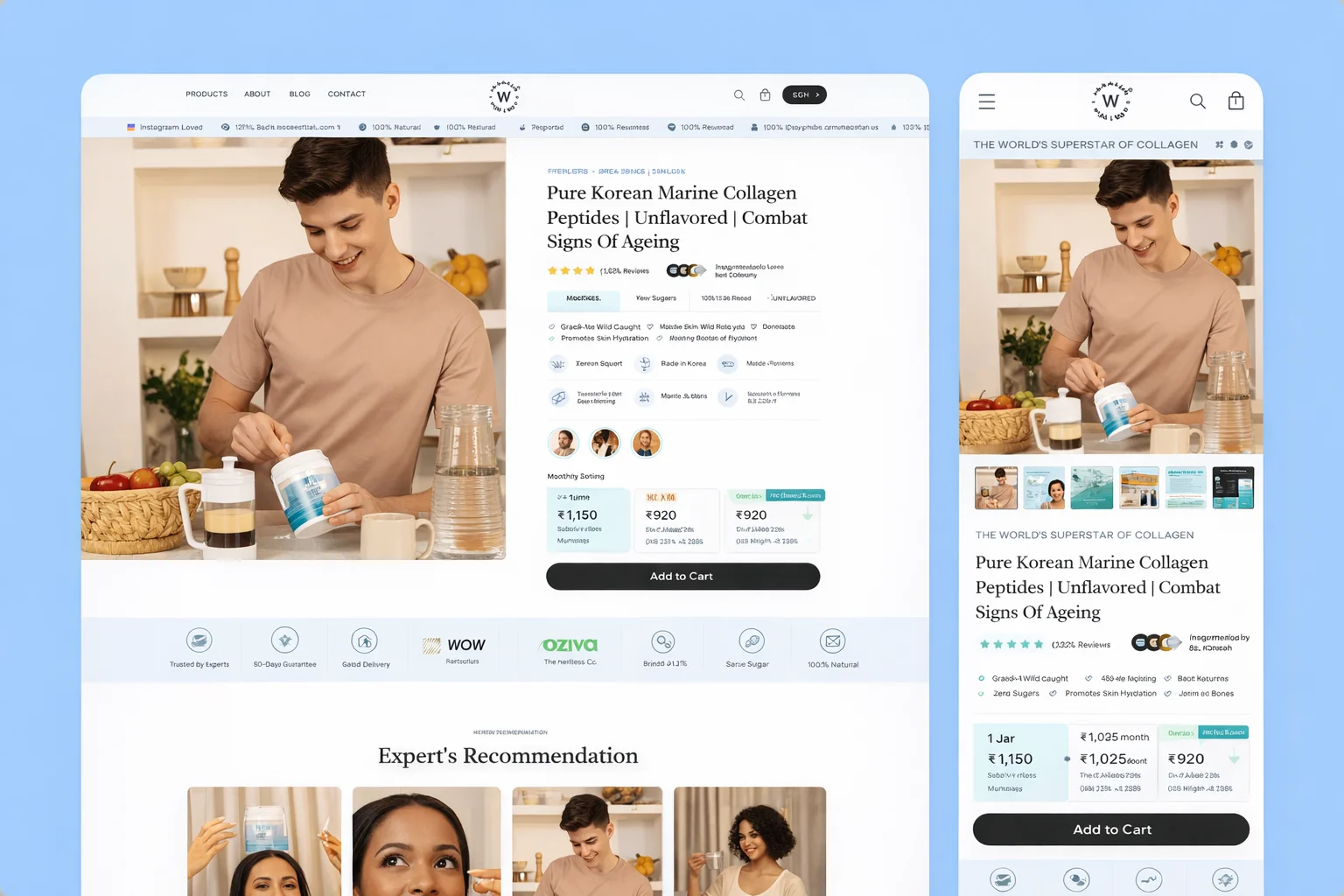
CRO work sits on top of build work. These are stores where the design and the development were both ours, which is usually why we can move a page quickly when a test says to.

Where conversion actually leaks

Five things we find on almost every product page.

Not a checklist we invented. These are the ones that keep turning up, roughly in the order they cost money.

01

The choice on the page argues for nothing

Pack sizes, variants and tiers presented as plain options, with no price, no unit cost and no reason to prefer one. This is the single most common miss we see, and it is what the InStrength test fixed. It is structural, not copy — and it is usually the cheapest win available.

02

The proof is on the page but not at the decision

Clinical results, certifications, review counts and third-party testing sitting in a tab, a carousel, or below the fold. Hesitation happens beside the price. That is where the evidence has to be, stated specifically enough to be checkable.

03

The primary action is not the loudest thing

Add to cart rendered as an outlined control next to a quantity stepper, quieter than a Buy Now beside it. Every extra decision between wanting the product and owning it costs conversions, and most pages have more of them than anyone intended.

04

Mobile was an afterthought

Most DTC traffic is mobile, and most product pages are designed on a desktop. If the pack selector and the review count are not above the fold on a phone, the page is being judged on something other than what you optimised.

05

Nothing is being measured

Changes shipped straight to 100% of traffic, compared against last month. That is not a result — it is a season, a promotion, or a change in traffic mix. If a store cannot tell a win from a good week, it cannot compound.

How we start

You only pay if it wins.

We rebuild one product page — the one carrying your ad spend, or your hero SKU. It goes live as an A/B test against your current page. If our version doesn't win, you don't pay, and you keep the page you had.

We can offer that because the test decides, not us. It also puts the risk of a first engagement on our side of the table rather than yours. If it wins, you pay for that page, and then you decide whether we carry on.

Pick a page to test
  • One page: the PDP behind your ads, or your best seller
  • Shipped live as an A/B test against your current page
  • If it doesn't win, no invoice — and your original page stays
  • If it wins, you decide whether we continue

Choosing an agency

Five questions worth asking. Ask us too.

If you are comparing CRO agencies, these separate them faster than a portfolio review will. Our answers are underneath each one.

Can you show me a test that lost, or one that proved nothing?

The most useful question available. Anyone running a real volume of tests has plenty of both — roughly half of all tests fail to beat control. An agency whose case studies are all wins is showing you a selection, not a record.

Our answer

Pawpeye is on this page with its dashboard, and we say in plain language that the result has not settled. It would have been trivially easy to publish it as a 77% lift, which is what the raw numbers say. We think that number is not real yet.

What sample size did that case study run on?

The question that deflates most CRO marketing. A large percentage lift on a few hundred visitors and a handful of conversions is noise with a confident caption. Ask for visitors, conversions per variant, and the win probability.

Our answer

Every figure we publish carries its sample. InStrength: 546 visitors, six days, p = 0.02. Pawpeye: 287 visitors, 11 conversions against 6, 87.4% — below the bar, and labelled that way.

How will we agree what winning means?

Get the primary metric in writing before anything ships. "Conversion improved" measured against last month is a season, a promotion, or a change in traffic mix.

Our answer

One primary metric agreed before we start, usually add-to-cart rate. Even 50/50 split against your current page, reported from the dashboard you can open yourself. If a page cannot reach a conclusion in a sensible window, we say so before starting rather than running a test neither of us can read.

Who writes the code that ships the variant?

CRO that cannot ship is a slide deck. Plenty of agencies deliver recommendations and leave implementation to whoever built your theme, which is where most of the delay and half the misinterpretation comes from.

Our answer

The person who scopes the test builds it. We build the stores too, which is usually why we can turn a variant around quickly when a test tells us to move.

What happens if it doesn't work?

The answer tells you how the risk is shared. A fixed fee regardless of outcome is normal and defensible — but you should know that is what you are buying.

Our answer

No invoice, and your original page stays live. That is the offer above: we take the first engagement on the result rather than on the hours.

Where our clients are

US, UK and Europe, Australia.

Conversion work travels better than most ecommerce disciplines — the structural problems are remarkably similar across markets. What changes is traffic volume, which decides how fast a test can settle.

United States

Usually the easiest place to test, because the traffic is there. A page with real US volume can reach a conclusion in days rather than weeks, which changes how much you can learn in a quarter.

United Kingdom & Europe

Smaller per-market volume, so tests take longer to settle and the temptation to call them early is stronger. We would rather run one page properly than four inconclusively.

Australia & New Zealand

Domestic volume is modest, which makes test design matter more. Shipping thresholds and pack economics tend to be the highest-leverage things to test here.

We work asynchronously and overlap live for calls. The test runs in your dashboard and you see exactly what we see.

Questions

The ones we get asked.

Something not covered here? Ask us directly.

At the useful end: finds where a store loses people, forms a hypothesis about why, rebuilds the page around it, and runs the new version against the old one as a controlled test so the result is attributable. At the less useful end: delivers a document of best practices and leaves implementation and measurement to you. The difference is whether anyone can tell afterwards if it worked.

Typically two to four weeks on a page with reasonable traffic. The InStrength test reached significance in six days, which was unusually fast and reflects how large the difference turned out to be. Pawpeye ran seventeen days and still had not settled. If a page does not get enough visitors to conclude in a sensible window, we will tell you before starting instead of running a test neither of us can read.

No, and be wary of anyone who says otherwise. That is one page, one brand, 546 visitors, six days, with a confidence interval running from about +9% to +106%. It is a real result we can produce evidence for, not a rate we can promise to reproduce. What we commit to is the method and the terms: your page against ours, split evenly, no invoice if ours does not win.

It is where we start, because it is where the money usually is and where a test can settle fastest. Collection pages, cart and the path between them are all fair game once a first test has established how your traffic behaves. We would rather prove the method on one page than redesign a funnel on a hypothesis.

We work almost entirely on Shopify and Shopify Plus, and that focus is the reason we can move quickly. If you are on another platform we would usually tell you to find someone who lives in it rather than learn yours at your expense.

CRO work starts at $5K and a full audit runs between $3K and $15K depending on scope. Those are starting points rather than quotes — we fix the number in writing after a discovery call so it does not move afterwards. The single-page test described above is the exception: you pay only if it wins.

Next step

Send us the product page you are least happy with.

Not a brief, not a deck. One URL and a sentence about what you think is wrong with it. You will get a real read within a business day — including, sometimes, that the page is fine and the problem is upstream of it.

Clutch Premier VerifiedShopify Partner